
We begin this week’s Torah reading highlighting an odd contradiction conflicting with a standard unofficial rule of the Torah. The Torah is famously stingy with words, our sages teach that not a single letter is wasted, that entire laws hang on an extra vav or a seemingly superfluous phrase. And yet, this week we open the book of Devarim (Deuteronomy), where Moses spends an entire book, retelling a story we already know. The wilderness. The spies. The rebellions. The mountain. We heard it all already, back in Shemot and Bamidbar. So why tell it again?
...
Our great sage Rashi, in his very first comment on Devarim, notices something important: Moses doesn't simply repeat the story, he retells it in code, alluding to the people's failures rather than listing them outright, out of respect for those who are about to enter the land. In other words, this isn't a rerun. It's Moses, older now, standing at the edge of the Jordan with a nation he has raised from slavery to sovereignty, choosing his words with the wisdom of hindsight. Same events. Different voice. Different moment. Different people listening.
This is the real secret of repetition, in Torah, and in life. We tend to treat repetition as the enemy of growth. The same commute. The same arguments. The same Torah portion, again, right on schedule every year. It's easy to hear "Devarim" and think: didn't we just do this?
But consider Bill Murray in Groundhog Day. The day repeats, precisely, maddeningly, down to the same alarm clock at 6:00 a.m. Nothing about the day changes. What changes is the protagonist. By the end, he's not living the same day at all, because he is no longer the same man living it. The repetition wasn't the obstacle to his growth; it was the mechanism of it.
This is exactly what happens every single year when we return to the Torah. The words don't change. The trope doesn't change, the very same melody, carried mouth to mouth, teacher to student, across centuries, echoing something first chanted in Jerusalem long ago. But we change. We are not the people who read Devarim last year. We've buried people we loved. We've celebrated simchas. We've worried about our children, our community, our people. So, the same verse lands differently, because a different person is receiving it.
Which brings me to why I end these messages, week after week, the same way I have for years: “Because we are Stronger Together.”
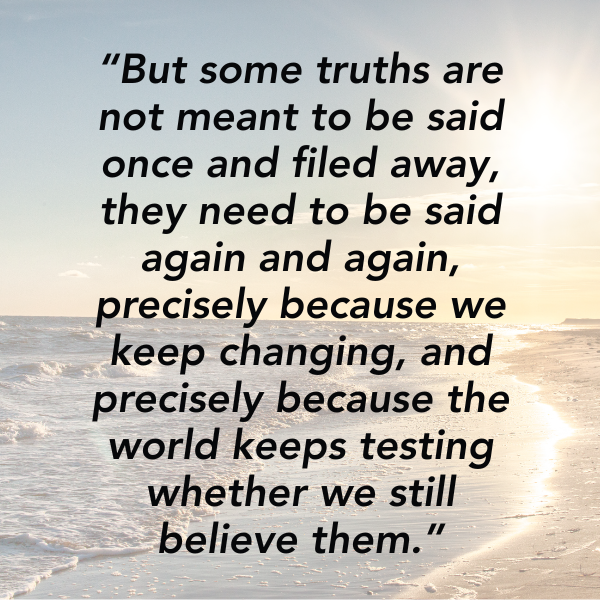
I could vary it. I could find new words each time. But some truths are not meant to be said once and filed away, they need to be said again and again, precisely because we keep changing, and precisely because the world keeps testing whether we still believe them. In a moment when hatred toward Jews is at an all-time high, and when we sometimes turn on each other before any outside threat even arrives, repetition is not fatigue. It is fidelity.
We are one nation, one history, one purpose, one faith, bound to one Gd. If we don't keep repeating to ourselves this message, like Moses did, like we do every year, then what, exactly, are we here to accomplish? Because we ARE Stronger Together.
Shabbat Shalom.
|

|