
There's a phrase most of us have heard at one time or another, usually when a gift doesn't quite achieve its desired outcome: "It's the thought that counts."
This sentiment is a kind thing to say. But candidly? It's not a very Jewish thing to say.
This week's double portion, Vayakhel-Pekudei, opens with Moses gathering the entire Israelite community for one of the Torah's most remarkable moments. Moses doesn't levy a tax. He doesn't issue a command. He simply asks that those "whose hearts move them" (kol nediv libo) bring gifts for the building of the Mishkan, the Tabernacle, Gd's dwelling place among the people. And when it comes time to actually build it, Moses doesn't choose the strongest workers or the most obedient soldiers. He chooses the chachmei lev, literally, the "wise-hearted artisans," people whose technical skill and inner spirit were inseparable from one another.
Right here, in the architectural plans for this sacred space, the Torah is whispering something important to us: kavanah, intention, mindfulness, the inner life we bring to what we do, matters deeply. You cannot build a home for the Divine with a vacant heart.
And yet, and here's where Judaism gets beautifully complicated, the Torah never lets us stop there.
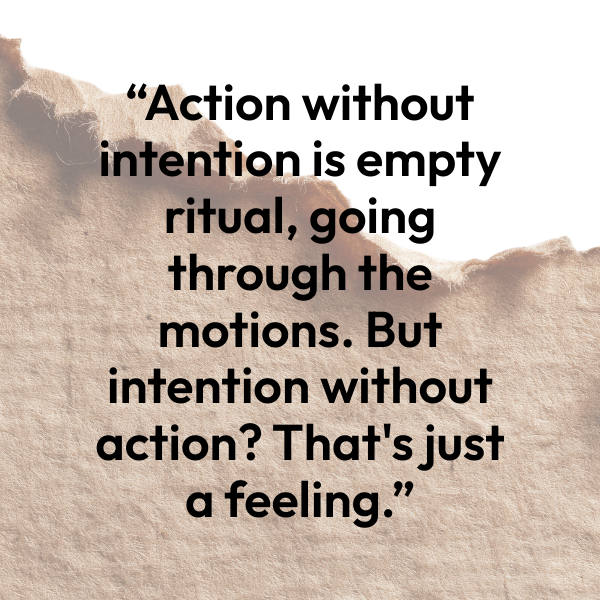
Jewish law has wrestled for centuries with the tension between kevah (fixed, obligatory action, just “doing” the mitzvah) and kavanah (the meaning and intention we bring to its fruition). And our tradition's answer has never been to pick a winner. Because neither, on its own, is enough. Action without intention is empty ritual, going through the motions. But intention without action? That's just a feeling. And as lovely as feelings are, feelings alone don't build a Mishkan.
Rambam, the great Maimonides, in his famous eight rungs of tzedakah (charitable giving) tells us that giving “willingly” is a higher spiritual act than giving “grudgingly.” Kavanah matters. And yet, in the very same teaching, he reminds us that a larger gift does more to feed a hungry family than a smaller one. Impact is real, and Rambam never minimizes it. What he asks us to do is look inward, not to compare ourselves to others, but to ask honestly: am I giving at the level I am capable of, and am I giving with an open heart? That accounting, Rambam teaches, is between each of us and Gd alone.
Both of these things are true at the same time.
This is not a flaw in our tradition. This is the genius of it.
We live in an age that craves simple answers, yes or no, right or wrong, support or oppose. But Vayakhel-Pekudei, with its careful accounting of every plank and curtain hook alongside its insistence on willing hearts, reminds us that we live in the full spectrum of color, not the black and white extremes. Moral life doesn't come with clean lanes and clear guardrails. It blends and shifts and demands that we hold complexity with humility.
And nothing illustrates that complexity more painfully than the world we are living in right now.
As we, here in Greater Naples, gather this Shabbat, Israeli families are sheltering in their bomb shelters as war with Iran continues to rain missiles on Israel and real loss of life befalls. People have died. Families have been shattered. And the stated purpose of all of it, the agonizing, terrible kevah of military action, is shalom. Peace. How strange. How heartbreaking. How deeply, unavoidably human.
Because Judaism has always understood that wanting peace is not the same as making peace. That kavanah, the fierce, unwavering intention to build a safer and more just Middle East, does not spare us from the hard and costly kevah of what that sometimes requires. The thought, however pure, is not enough. The action, however necessary, must be rooted in something higher than itself.
May those living in fear find safety soon. May those who have been lost be held in loving memory. And may we, like the chachmei lev (the wise-hearted ones) find the strength to act in this complicated world with both open hands and full hearts. Because we are Stronger Together.
Shabbat Shalom,
|

|