
This week's Torah portion, Shoftim, provides us insight into a law that at first glance seems incredibly dated and irrelevant. In the middle of instructions about warfare, we're told that when one besieges a city, we may not destroy its fruit-bearing trees. The Torah asks, almost incredulously: "for is the tree of the field a man, that it should enter the siege before you?" (Deut. 20:19). We are instructed to never take out our wartime aggression on something that feeds the people.
...
The comparison is easy to make. Like a tree, a person needs roots, family, community, memory, to stay grounded. We need seasons of growth and seasons of rest. We bend in storms, so we don't break. We bear fruit to share with others, not just to keep for ourselves. It's a beautiful, familiar metaphor.
But the Torah doesn't stop at protecting the fruit trees. Deuteronomy 20:20 delivers a twist: even the trees that do not yield fruit, trees that could be lawfully cut down and used for the siege, must stop being cut down the moment they're no longer needed. Necessity has a shelf life. What was permissible under pressure becomes forbidden once the pressure is gone.
Think about how this plays out in our own lives. In the heat of an argument, we share the sharp response. We fire-off the terse email. We give someone the cold shoulder because, in that moment, we felt justified, attacked, dismissed, hurt. Maybe we were even right to feel that way. But weeks or months later, we're still holding the grudge, still keeping our distance, still "at war" with someone long after the actual conflict ended. The siege is over. The wall no longer serves a purpose. It's just costing us, and them, something that used to grow.
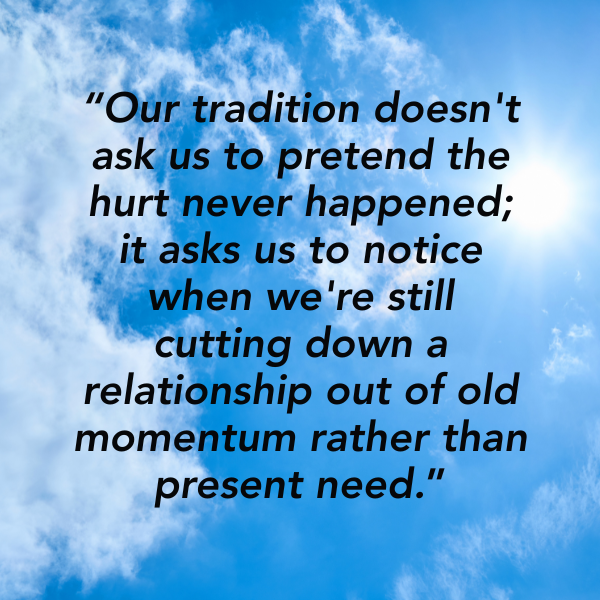
This is why we were given the month Elul. Our tradition doesn't ask us to pretend the hurt never happened; it asks us to notice when we're still cutting down a relationship out of old momentum rather than present need. Elul gives us a structured, communal permission slip to reach out first, to say "I'm sorry" or "I forgive you" without it being a sign of weakness. Elul is not for flowery sentiment; it's a practical, once-a-year opportunity our tradition builds in, so the grudges we're carrying don't outlive the proverbial battles fought.
One way our Jewish Federation is leaning into that work together this Elul is through Elul-ination, our daily email series featuring short reflections ("sparks") on the values and themes of this season. Sign up to get a spark in your inbox each morning, or visit jewishnaples.org/elul-ination, updated daily with the newest reflection.
May this Elul give us the clarity to see which trees we're still needlessly cutting down, and the courage to let them begin growing again. Because we are Stronger Together.
Shabbat Shalom.
|

|